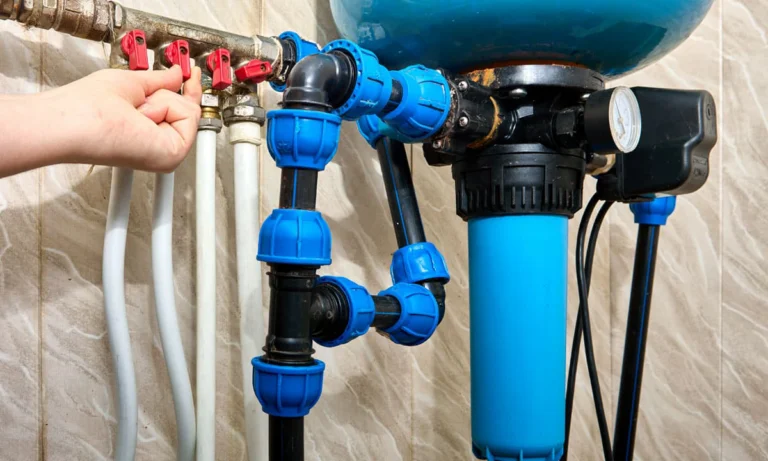
In most cases, yes — a whole-house water filter can be installed on your existing plumbing system without major modifications. The key variables are your home’s pipe material, the location of your main water supply line, and what you’re trying to filter out. For Denver-area homeowners dealing with Colorado’s notoriously hard water, sediment from older distribution lines, or concerns about water quality, a properly selected and installed whole-house filter is one of the most impactful plumbing upgrades you can make.
How Whole-House Water Filters Work
Unlike under-sink or countertop filters that treat water at a single point of use, whole-house systems — also called point-of-entry (POE) filters — install on the main supply line where water enters your home. Every fixture and appliance in the house receives filtered water: showers, washing machines, dishwashers, ice makers, and every faucet. This protects not just drinking water but also your appliances and pipes from the sediment, minerals, and contaminants that shorten their service life.
What Colorado’s Water Actually Contains
The Front Range has some of the hardest water in the country. Denver-area water typically measures 100–200+ parts per million of calcium and magnesium carbonate — enough to leave visible mineral scale on showerheads and fixtures within months and to significantly shorten the life of water heaters, dishwashers, and washing machines. Scale buildup inside a water heater reduces its efficiency and can cut years off its lifespan. A whole-house water softener or salt-free conditioner paired with a sediment and carbon filter addresses this directly.
Beyond hardness, Denver’s treated municipal water meets EPA standards, but some homeowners prefer additional filtration for chlorine taste and odor, chloramines (used as a disinfectant in some municipal systems), or trace sediment from aging distribution infrastructure. If you’re on well water, your filtration needs depend entirely on what your well test reveals — anything from iron and sulfur to bacteria may require specific treatment.
Types of Whole-House Filtration Systems
- Sediment filters — The most basic and often the first stage in any whole-house system. Removes particulates, rust, and debris that can clog fixtures and appliances. Cartridges require periodic replacement.
- Carbon block filters — Remove chlorine, chloramines, herbicides, pesticides, and VOCs that affect taste and odor. Often used as a second stage after sediment filtration.
- Water softeners (ion exchange) — The gold standard for hard water treatment in Colorado. Exchange calcium and magnesium ions for sodium ions, preventing scale buildup throughout the home. Require a salt supply and periodic regeneration cycles.
- Salt-free conditioners (template-assisted crystallization) — Don’t remove hardness minerals but change their crystalline structure so they don’t adhere to surfaces. No salt required, no wastewater produced, but they don’t reduce measured hardness — a trade-off worth discussing with a water quality professional.
- Iron and manganese filters — Essential for well-water homes with metallic taste, orange staining on fixtures, or reddish water.
Installation Requirements and Compatibility
Whole-house filter installation requires access to your main water supply line before it branches to the rest of the home — typically in a utility room, crawl space, or basement. The installer will shut off the main water supply, cut into the supply line, and install the filter housing in-line with bypass valves so the system can be serviced without cutting off water to the entire house. Copper, PEX, CPVC, and galvanized pipe are all compatible with proper fittings. The process typically takes 2–4 hours depending on the complexity of the system and the accessibility of your supply line.
If your home has very low water pressure to begin with, some filter configurations can reduce it further — Done’s plumbers will check your incoming pressure before recommending a system to ensure you end up with adequate flow throughout the house.
Ongoing Maintenance
Whole-house filters aren’t set-and-forget systems. Sediment and carbon cartridges need replacement every 3–12 months depending on your water quality and household usage. Water softeners need salt replenishment and occasional resin bed cleaning. Neglecting maintenance reduces filtration effectiveness and, in the case of neglected carbon filters, can actually allow bacteria to grow in spent media. Done can set up a maintenance reminder or service schedule so your system stays effective.
To learn more about water filtration, softening, and treatment options, visit our water quality treatment page, or explore plumbing services to see the full range of what Done offers. Contact us to schedule a water quality assessment — we’ll test your water and recommend a filtration approach matched to what’s actually in it.