Draining and flushing your water heater once a year is the standard recommendation for most homes — but in the Denver area, where water hardness is well above the national average, doing it every six to twelve months is better practice. Hard water deposits sediment at the bottom of the tank faster than in softer-water regions, and that sediment accelerates corrosion, reduces efficiency, and shortens the heater’s lifespan.
Why Sediment Buildup Is a Bigger Problem in Colorado
Denver’s water supply is classified as hard to very hard depending on the source and season. Hard water carries dissolved calcium and magnesium minerals that precipitate out of solution when water is heated. In a storage tank water heater, these minerals settle to the bottom and accumulate in a layer of sediment. Over time that layer acts as insulation between the burner and the water, forcing the heater to run longer to reach the set temperature. You’ll often hear this as a popping or rumbling sound when the burner fires — the sound of water trapped under the sediment layer boiling and forcing its way through. That thermal stress adds wear to the tank lining and to the heating element in electric units.
What Draining the Water Heater Actually Does
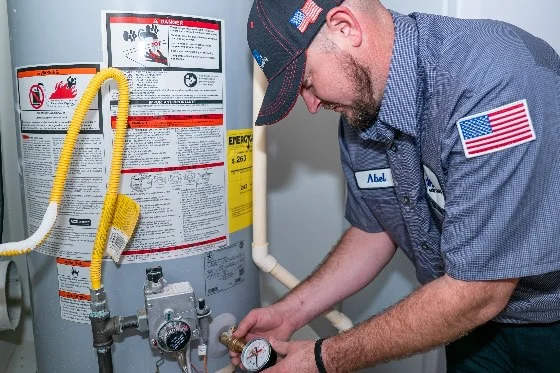
Flushing the tank removes accumulated sediment before it can compact into a hard layer that resists removal. The process involves shutting off the cold water supply, connecting a hose to the drain valve at the base of the tank, and allowing the tank to drain fully into a floor drain or outside. On a heater that hasn’t been flushed in years, the initial water coming out may be discolored and gritty — that’s the sediment you’re removing. After the tank drains, briefly reopening the cold supply while the drain is still open helps stir and flush remaining sediment. The tank is then refilled, the burner or element is restarted, and the anode rod is inspected while the heater is accessible.
The Anode Rod: Don’t Skip This Step
When a professional flushes your water heater, the anode rod should be checked at the same time. The anode rod — typically magnesium or aluminum — is a sacrificial component that corrodes in place of the tank lining. It’s the main reason a well-maintained water heater can last 10 to 15 years instead of 6 to 8. In hard water like Denver’s, anode rods deplete faster than average because the minerals in the water are more reactive. A rod that is more than 50 percent depleted should be replaced. A rod that has been ignored long enough may be completely gone — at which point the tank itself starts corroding from the inside. Annual maintenance that includes an anode rod check is one of the highest-return investments you can make in your water heater.
Tankless Water Heaters Still Need Maintenance
If you have a tankless water heater, you don’t drain it the same way, but you still need annual descaling. Scale builds up inside the heat exchanger — the component that transfers heat to the water — and reduces efficiency and flow rate over time. Descaling involves circulating a food-safe descaling solution through the unit to dissolve mineral deposits. In Denver’s hard-water conditions this is not optional maintenance; it’s the difference between a tankless unit that lasts 20 years and one that fails at 10.
When to Call a Professional Instead of DIY
Flushing a water heater is one of the more DIY-accessible maintenance tasks, but there are situations where a professional should handle it. If the drain valve leaks after being opened — which is common on plastic-bodied valves that haven’t been turned in years — it needs to be replaced, which requires draining the tank completely and working on live plumbing. If the anode rod is seized, removing it requires a breaker bar and the right socket size, and overtorquing it on an older tank can crack the fitting. A water heater maintenance visit from Done covers flushing, anode rod inspection and replacement, and a check of the pressure relief valve — all in one visit.
- Drain and flush annually in most homes; every 6–12 months in Denver’s hard-water conditions
- Inspect and replace the anode rod at the same time
- Check the pressure relief valve for proper operation
- Descale tankless units annually — no draining, but required maintenance
- Replace a leaking drain valve before it becomes a water damage event
- Document maintenance dates — it supports warranty claims and resale disclosures
Done’s plumbing team handles water heater maintenance for tank and tankless units throughout the Denver metro. If you’re not sure when your heater was last serviced — or you’re hearing rumbling when it fires — it’s time to schedule a visit.