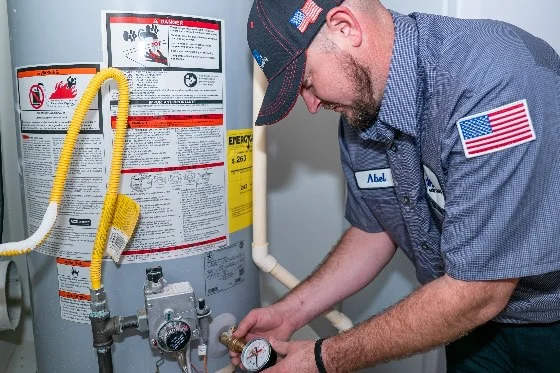
Cleaning a hot water heater — more accurately described as flushing it — means draining out the sediment that accumulates at the bottom of the tank over time. For Denver-area homes with hard water, that sediment is mostly calcium and magnesium scale, and it builds up faster here than in softer-water regions. Flushing annually keeps the heater running efficiently, extends its lifespan, and reduces the popping and rumbling sounds that signal a sediment problem. The process is straightforward, but it requires care around hot water and gas or electrical connections.
What You’re Actually Cleaning
Most homeowners think of “cleaning” a water heater as something that happens to the outside — wiping down the cabinet, checking connections. But the meaningful maintenance happens inside, where minerals from your water supply settle to the tank floor each time the heater cycles. Over months and years, that layer of scale insulates the burner from the water, forces the unit to run longer and hotter to achieve the same output, and can eventually crack the tank lining. In Denver, where water hardness runs moderate to high across most of the metro, this isn’t a hypothetical risk — it’s a predictable reality.
Step-by-Step: How to Flush a Tank Water Heater
Before starting, gather a garden hose long enough to reach a floor drain or exterior, and a flathead screwdriver. Allow yourself an hour, though the active work is much less than that.
- Turn off the heat source. For gas heaters, set the thermostat to the “pilot” or “vacation” setting — do not shut off the gas entirely unless you’re comfortable relighting the pilot. For electric heaters, turn off the dedicated circuit breaker.
- Connect a garden hose to the drain valve at the base of the tank and run it to a safe drain location. The water will be hot — do not run it across a lawn or to a location where people or pets could contact it.
- Open a hot water tap somewhere in the house. This prevents a vacuum from forming and allows the tank to drain freely.
- Open the drain valve (turn counterclockwise). Water will begin flowing through the hose. It will be discolored and may carry visible sediment — that’s what you’re removing.
- Flush with cold supply water. Once the tank is mostly drained, briefly open the cold water inlet to stir up remaining sediment and flush it out. Repeat until the outflow runs clear.
- Close the drain valve, remove the hose, let the tank refill completely (keep the hot tap open until water flows steadily without air sputtering), then restore heat.
Drain Valves That Won’t Cooperate
One common snag on older tanks: the plastic drain valve seizes up or snaps when you try to open it. This happens frequently on heaters that have never been flushed, where mineral deposits have essentially cemented the valve. If the handle won’t turn or breaks, stop and call a plumber. A broken drain valve on a full tank of hot water is not a good DIY situation. A plumber can replace the valve and complete the flush safely.
Similarly, if the water never runs clear after several flushes — or you hear grinding sounds as sediment passes through — the buildup may be severe enough that a professional flush with a descaling treatment is the better approach.
Don’t Forget the Anode Rod
A full cleaning service should also include inspecting the anode rod — a magnesium or aluminum rod that sacrificially corrodes inside the tank to protect the steel lining. Most manufacturers recommend checking it every three to five years; in hard-water areas like Denver, it can deplete faster. A fully depleted anode rod means the tank lining is now corroding directly, which accelerates its path to failure. Replacing an anode rod is inexpensive compared to replacing a tank.
How Often Should You Do This?
Annual flushing is the standard recommendation for most tank water heaters, and it’s especially important in hard-water areas. If your heater is making noise or you’ve never flushed it and it’s more than a few years old, start now — but manage expectations. A heavily scaled tank may only partially improve, and if the unit is more than ten to twelve years old, the flush may reveal that replacement is the smarter investment.
The Done team provides professional water heater maintenance that includes flushing, anode rod inspection, and a full system check. If it’s time for a new unit, we can help you compare traditional tank, tankless, and heat pump water heater options. Explore everything on our water heater services page.