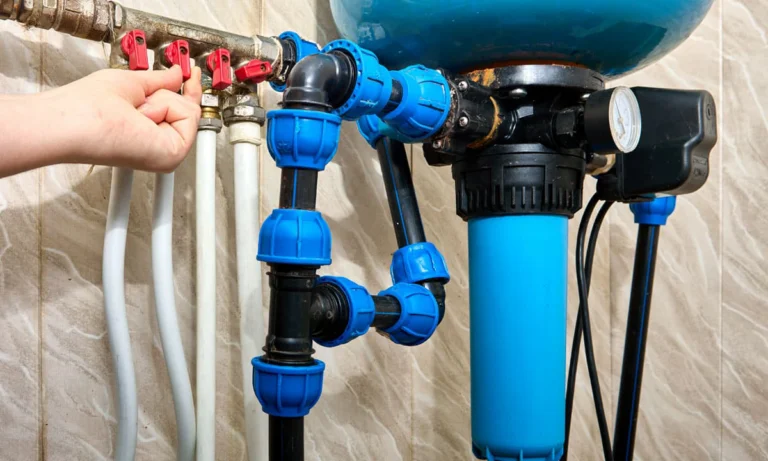
A whole-house water filter — also called a point-of-entry (POE) filter — is installed on the main water supply line where it enters your home, so every tap, shower, appliance, and fixture receives filtered water. Unlike a pitcher filter or under-sink unit that treats water at a single point, a whole-house system treats all the water before it ever reaches your plumbing. The filtration method depends on the type of system: sediment filters, carbon block filters, and specialty media each target different contaminants.
The Filtration Process, Step by Step
Most whole-house filter systems use multiple stages, with each stage designed to remove different things:
- Stage 1 — Sediment pre-filter: A pleated or spun polypropylene cartridge captures larger particles — sand, silt, rust flakes, and scale — before they reach downstream components. In Colorado, older homes with galvanized pipes or homes on well water often see significant sediment.
- Stage 2 — Activated carbon: Carbon is highly porous at the microscopic level, giving it enormous surface area. As water passes through, chlorine, chloramines (used by Denver Water), herbicides, pesticides, and many VOCs adsorb onto the carbon surface and are removed from the water stream. This stage also addresses taste and odor.
- Stage 3 (in some systems) — Specialty media: Depending on your water quality, additional media can target specific contaminants — KDF media for heavy metals and bacteria control, catalytic carbon for chloramines, or iron-reduction media for well water with high iron content.
How Water Quality in Colorado Affects What You Need
Colorado’s Front Range water supply comes primarily from mountain snowpack and reservoirs. Denver Water treats its supply with chloramine (a chlorine-chloramine blend) rather than straight chlorine — which is more stable in distribution but requires catalytic carbon, not standard carbon, for effective removal. Water in the Denver metro is also relatively hard, with dissolved calcium and magnesium minerals that build up as scale inside water heaters, pipes, and appliances. A whole-house filter alone won’t address hardness — that requires a water softener or salt-free conditioner, which some homeowners pair with their filter system.
What a Whole-House Filter Does Not Remove
It’s important to match your filter to what’s actually in your water. Most standard whole-house carbon filters do not remove dissolved minerals (hardness), nitrates, heavy metals like lead, fluoride, or biological contaminants like bacteria and viruses. For those concerns, additional treatment technologies — reverse osmosis, UV purification, or a water softener — are needed. A water quality test is the best starting point before choosing any treatment system.
Maintenance: What Keeping a Whole-House Filter Running Requires
Whole-house filters aren’t install-and-forget. Cartridges have a finite capacity measured in gallons, and once saturated they stop filtering effectively — or in the case of a clogged sediment filter, they begin restricting water pressure throughout the house. Most sediment pre-filters need replacement every 3–6 months; carbon cartridges typically last 6–12 months depending on usage and local water quality. Some systems have automatic backwash cycles that extend service intervals. Either way, following the maintenance schedule is what keeps the system doing its job.
Professional Installation vs. DIY
Whole-house filter installation involves cutting into the main supply line and, in some cases, working near the water meter shutoff or adding bypass valves. While a capable DIYer can handle the task, an improper installation can create leaks, reduce water pressure, or void a product warranty. A licensed plumber ensures the system is sized correctly for your home’s flow rate (measured in gallons per minute), installed with proper bypass valves for maintenance, and positioned to work with your existing plumbing layout.
Done’s plumbing team can test your water, recommend the right filtration approach, and install it correctly. See water quality treatment for more, and explore our full plumbing services if you have other water-related concerns at home.