The air handler — the indoor unit of a central HVAC system that contains the blower, evaporator coil, and filter — is most commonly located in a utility closet, basement, attic, or garage depending on your home’s age and design. In most Denver-area single-family homes, it’s in the basement mechanical room or a dedicated indoor closet on the main floor. If your home has a furnace with an air conditioning coil stacked on top, the entire assembly is your air handler.
Common Air Handler Locations by Home Type
Denver’s housing stock spans a wide range of eras and construction styles, and air handler placement varies accordingly. Here’s what’s typical for the most common home types in the metro area:
- Ranch-style homes with basements (1950s–1970s): The air handler or furnace-plus-coil is almost always in the basement mechanical room, often near the water heater. Ductwork runs up through the floor to supply registers.
- Two-story homes: The air handler may be in the basement for the lower zone and in the attic for an upper zone, especially in homes with two-zone HVAC. Some two-story homes have a single air handler in a hall closet or garage.
- Newer construction (2000s–present): In slab-on-grade homes without basements, the air handler is often in a dedicated indoor closet (sometimes called an “air handler closet”) or in the garage. Attic installations are less common in Colorado than in warmer climates because of freeze risk.
- Townhomes and condos: These often have the air handler in a small utility closet inside the unit — sometimes in a hallway or behind louvered doors in a bedroom area. Space is usually tight.
How to Identify Your Air Handler
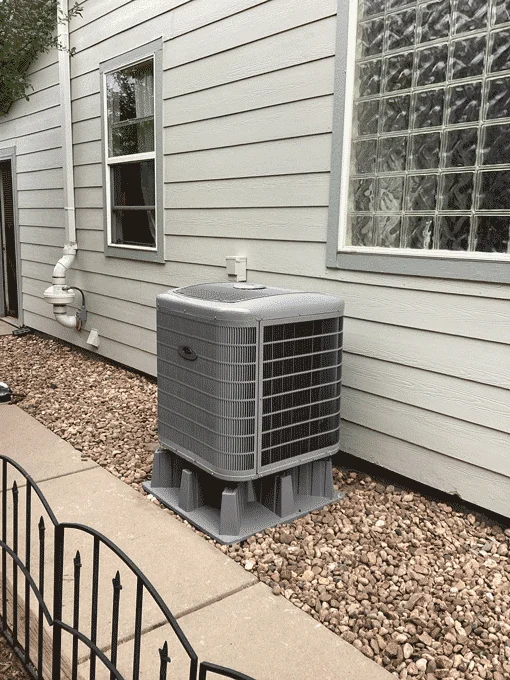
If you’re not sure which unit is your air handler, follow the ductwork. Your home has supply ducts (carrying conditioned air to rooms) and return ducts (pulling air back from rooms). Both connect to the air handler, so if you trace the large duct trunk lines back to a mechanical cabinet with a blower inside and a filter slot, you’ve found it. The outdoor unit — the condenser or heat pump compressor — is a separate piece of equipment connected to the air handler by refrigerant lines and electrical wiring.
In a gas forced-air system, the furnace itself serves as the air handler — the blower inside the furnace moves air across the evaporator coil (mounted on top of or beside the furnace) during cooling season and across the heat exchanger during heating season. In a heat pump or air conditioning system without a furnace, the air handler is a separate cabinet that contains only the blower and coil.
Why Knowing Your Air Handler’s Location Matters
Your air filter is almost always located at or inside the air handler — either in a slot in the cabinet itself or in a return air grille nearby. Knowing where your air handler is means you can find and replace your filter regularly, which is the single most impactful maintenance task a homeowner can do. Colorado’s dry, dusty air and wildfire smoke season mean filters here load up faster than manufacturer schedules suggest — checking monthly and replacing every 60 to 90 days is reasonable for most Front Range homes.
The air handler is also where technicians access the evaporator coil, blower motor, and condensate drain during service visits. Knowing where it is helps you make sure the space around it stays clear — at least two feet of clearance on all service sides — so technicians can work safely and efficiently.
Concerns About Your Air Handler’s Location or Condition
If your air handler is in an unconditioned attic in a Colorado home, it’s worth discussing with a technician whether the installation is appropriate. Attic installations can freeze in winter and overheat in summer, both of which stress the equipment and reduce efficiency. Poorly insulated attic ductwork in Colorado can also waste a significant amount of conditioned air before it reaches the living space. Our duct repair and replacement services address these issues, and our broader cooling and heating teams can assess whether your air handler placement is optimal for your home’s layout and Colorado’s climate demands.