A smart thermostat saves money by eliminating the waste that comes from heating and cooling an empty home at full comfort levels. Traditional programmable thermostats let you set a schedule, but most homeowners never fully program them or end up overriding them constantly. Smart thermostats learn your patterns, adjust automatically when you leave, and let you control settings remotely so you’re not paying to condition a house that no one is in. In Colorado’s climate, where both heating and cooling seasons are significant, those savings add up year-round.
What “Smart” Actually Means in a Thermostat
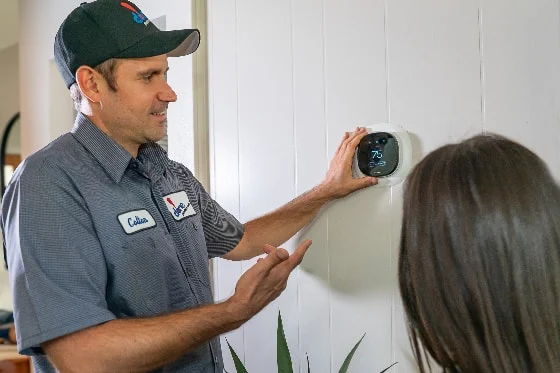
Smart thermostats connect to your home Wi-Fi and pair with a smartphone app. At the basic level this means remote control — you can adjust the temperature from anywhere, which is handy for turning the heat back up before you head home on a cold evening without paying to maintain that temperature all day. But the real value is in the automation features: geofencing (the thermostat detects when your phone leaves the home area and adjusts the setpoint automatically), occupancy sensing (some models use infrared or radar sensors to detect actual human presence in the home), and learning algorithms that track when you typically arrive, leave, wake up, and go to bed.
Models like the Nest Learning Thermostat and Ecobee SmartThermostat also gather local weather data and factor it into their decisions. If a cold front is arriving tonight, the thermostat knows it and can adjust how aggressively it pre-conditions the home. This is particularly relevant in Denver, where temperature can swing 40 degrees between a sunny afternoon and a cold overnight — a smart thermostat handles that variability better than a fixed schedule.
Specific Ways a Smart Thermostat Reduces Energy Use
- Setback during away hours: Allowing temperatures to drift 7–10°F while the house is unoccupied is one of the most impactful energy-saving moves available — industry estimates suggest this can reduce annual heating and cooling costs by up to 10% (verify with your specific utility and usage patterns)
- Optimized recovery: A smart thermostat learns how long your system takes to reach a target temperature and starts the recovery at the right time rather than blasting the system at full effort to catch up
- Runtime tracking: Most smart thermostats show you monthly runtime reports, which reveal patterns you wouldn’t otherwise see — like which days your system runs four times as long as usual
- Utility programs: Many Colorado utilities (Xcel Energy, for example) offer rebates and demand-response programs for smart thermostat users — you receive a small bill credit in exchange for allowing the utility to make modest temporary adjustments during peak demand events
Compatibility: Does Your HVAC System Work With a Smart Thermostat?
Most forced-air systems — gas furnaces, electric furnaces, heat pumps, and central AC — are compatible with the leading smart thermostat brands. The key compatibility factor is the C-wire (common wire), which provides constant 24V power to the thermostat. Older thermostats often didn’t use the C-wire, and some smart thermostats require it to function properly. Many HVAC systems have a C-wire already run to the thermostat location even if the old thermostat didn’t use it — a quick check of the wiring behind your existing thermostat will tell you. If there’s no C-wire available, there are adapter solutions, but they add complexity. An HVAC technician can confirm compatibility and complete the installation correctly in an hour or less for most systems.
Systems with more complex zoning, heat pumps with auxiliary heat, or hydronic (boiler) systems may have additional compatibility considerations. Don’t assume compatibility for anything beyond a straightforward single-stage furnace and AC setup without checking first.
What Smart Thermostats Can’t Fix
A smart thermostat optimizes how you use your HVAC system, but it can’t compensate for an inefficient system or a poorly insulated home. If your furnace is 20 years old and running at 80% AFUE when a modern model would run at 96%, or if your ductwork leaks significantly, those are bigger sources of energy waste than thermostat scheduling. Similarly, poor attic insulation or single-pane windows can overwhelm any thermostat strategy. A smart thermostat works best as part of an overall effort to improve home efficiency rather than as a standalone fix.
Done installs and services smart thermostats as part of our broader HVAC services. If you’re also thinking about a system upgrade or want to explore maintenance options that keep your existing equipment at peak efficiency, visit our AC maintenance or furnace maintenance pages, or check out the Done Care Club for ongoing maintenance benefits. Contact Done to schedule a visit.