Swamp coolers require consistent seasonal maintenance to perform well — more hands-on attention than a central air conditioner, but manageable if you stay on a schedule. The core maintenance tasks happen twice a year: a startup service in spring before cooling season and a shutdown service in fall before freezing temperatures arrive. Denver’s hard water and fine dust make regular attention especially important, since both accelerate wear on pads, sumps, and distribution systems faster than in softer-water, less-dusty climates.
Spring Startup: What Needs to Happen Before You Turn It On
Don’t simply flip the switch on your swamp cooler in May without checking these items first. A system that sat all winter needs a proper startup to perform well and avoid damage:
- Pad inspection and replacement: Cooling pads (aspen fiber or rigid media) should be inspected at startup and replaced if they’re matted, mineral-crusted, or deteriorated. Rigid media pads typically last 3–5 seasons; aspen pads usually need annual replacement in Denver due to hard water scale buildup.
- Sump and pan cleaning: Drain and clean the water reservoir at the bottom of the unit. Scale and sediment from Denver’s hard water accumulate over the season and over winter, and a dirty sump fouls the water distribution system.
- Water distribution system check: Inspect the water pump, distribution tubes or spider, and distribution clips. Mineral deposits clog the small holes in the distribution system, causing uneven pad saturation and reduced cooling.
- Belt inspection (belt-drive units): Check for cracking, glazing, or excessive slack. Replace if worn — a broken belt stops the blower mid-season.
- Blower motor and bearings: Lubricate motor and shaft bearings if they have oil ports. Listen for squealing during the first run — dry bearings fail quickly.
- Water line reconnection: The water supply line is typically disconnected for winter. Reconnect it, check for leaks at the fitting and float valve, and verify the float is adjusted to maintain the correct water level.
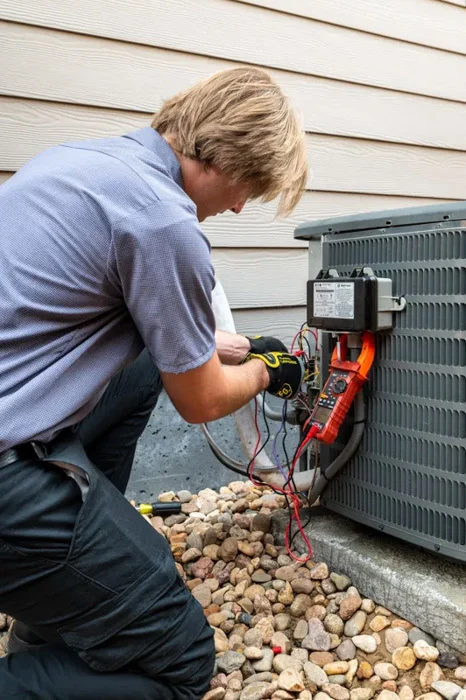
- Electrical inspection: Check the power connection, switch, and any timer or thermostat wiring for corrosion or damage after winter exposure.
Mid-Season Maintenance Through Summer
Even during the cooling season, a swamp cooler benefits from periodic attention. Every two to four weeks during operation, check the water level in the sump and adjust the float if needed. Flush the sump by draining and refilling it — this dilutes mineral concentration and slows scale buildup, which is a significant maintenance challenge with Denver’s hard municipal water supply. If your unit has a bleed-off valve, verify it’s working; continuous bleed-off is the most effective way to manage mineral concentration during the season.
If you notice reduced cooling performance mid-season, the pads are often the culprit — they can become clogged with minerals even within a single season in hard-water areas. Some homeowners keep a spare set of aspen pads on hand for a mid-season swap.
Fall Shutdown: Protecting the Unit Over Winter
Proper winterization protects the unit from freeze damage and sets you up for an easier spring startup. Shut off the water supply line and drain the system completely — water left in the sump or distribution lines will freeze and crack components. Clean the sump one final time for the season. Disconnect and store the water supply line if possible. Cover the unit with a quality swamp cooler cover to keep debris and blown snow out over winter. Disconnect power to the unit at the breaker or switch to prevent accidental activation.
Hard Water and Denver’s Maintenance Challenge
Denver’s municipal water is moderately hard, and the South Platte watershed water supply varies by neighborhood. Hard water leaves calcium and magnesium scale wherever it evaporates — which in a swamp cooler is everywhere. Scale reduces heat transfer efficiency through the pads, clogs distribution holes, and eventually damages the sump and pan if left unchecked. Using a swamp cooler treatment tablet or mineral inhibitor in the sump through the season measurably slows scale accumulation and extends the life of pads and components.
Done’s technicians can handle spring startup and fall shutdown service, keeping your evaporative cooler running efficiently through the season. Proper seasonal maintenance is also covered under our Care Club program. For questions about your swamp cooler or to explore whether a central cooling system might be a better fit for your home, contact Done and speak with a cooling specialist.