Denver’s climate is unusually favorable for multiple types of cooling systems, and the best choice for your home depends on your specific situation — house size, existing ductwork, budget, how often you’re home during the day, and your tolerance for the occasional humid week in late summer. The most common options for Front Range homes are central air conditioning, evaporative (swamp) coolers, heat pumps, and ductless mini-splits. Each has real strengths in Colorado’s environment, and each has trade-offs worth understanding before you invest.
Central Air Conditioning: Reliable, Widely Compatible
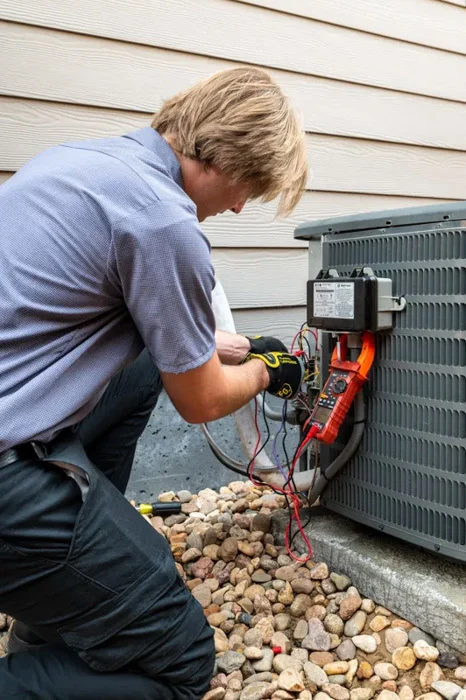
A central AC system — a condenser outside connected to an air handler or furnace coil inside, distributing conditioned air through ductwork — is the most familiar option and works well throughout Denver’s cooling season. It handles the full range of Colorado weather, including the occasional humid monsoon weeks in July and August when swamp coolers lose effectiveness. If your home already has ductwork in good condition, central AC is often the most straightforward choice.
The key for Denver homes is proper altitude-adjusted sizing. At 5,280 feet, thinner air reduces the efficiency of heat transfer through the refrigerant circuit, which means equipment that’s correctly sized at sea level may be marginally undersized at elevation. A Manual J load calculation from a knowledgeable local contractor accounts for this. Done’s installation team applies altitude-adjusted sizing for every new system we install on the Front Range.
Evaporative Coolers: The Colorado-Native Solution
Denver’s low summer humidity — typically 20–40% during peak cooling months — is exactly what evaporative cooling requires. A well-sized swamp cooler can drop indoor temperatures by 15–25 degrees while consuming a fraction of the electricity of a refrigerant-based system. Denver’s altitude enhances evaporative efficiency further, since water evaporates more readily in thinner, drier air. For homeowners focused on operating cost and environmental impact, a swamp cooler is hard to beat during most of the summer.
The limitation is the monsoon pattern. When moisture flows up from the Gulf of Mexico in July and August, Denver’s humidity can climb into the 50–70% range for days at a time, and evaporative coolers lose much of their effectiveness during those stretches. Some Denver homeowners install both a swamp cooler and a smaller conventional AC for exactly this scenario — using the swamp cooler for the bulk of the season and switching to AC during humid weeks.
Heat Pumps: All-Season Efficiency
Modern cold-climate heat pumps are a strong fit for Denver’s climate. They provide efficient cooling in summer and efficient heating through much of Colorado’s winter — maintaining strong heating capacity at temperatures well below freezing with current technology. For homeowners replacing both a furnace and an AC simultaneously, a heat pump system can simplify the mechanical room and, in many cases, reduce total annual energy costs. Dual-fuel systems — a heat pump paired with a gas furnace backup — give you the efficiency advantage of a heat pump most of the time with the security of gas heat on the coldest nights.
Ductless Mini-Splits: Precision Cooling Without Ductwork
Ductless mini-split systems are the right answer when you’re cooling a space that doesn’t have — or can’t practically be served by — ductwork. Additions, finished basements, detached garages, sunrooms, and older homes with radiator heating and no existing ductwork are all excellent candidates. Mini-splits are also worth considering for homeowners who want room-by-room temperature control, since each indoor head unit operates independently. They’re highly efficient, quiet, and eliminate the energy losses that occur when conditioned air travels through poorly sealed ductwork.
How to Choose for Your Specific Home
The best cooling system for a Denver home depends on the specifics: square footage and layout, existing mechanical infrastructure, your household’s schedule and usage patterns, and your budget for upfront cost versus ongoing operating cost. Done’s comfort advisors have helped thousands of Denver-area homeowners work through this decision. We’ll assess your home, explain the trade-offs for your situation, and give you a clear recommendation — along with options across price points and financing if needed. Explore Done’s full cooling services or contact us to schedule a consultation.